Learning to Get Lost
A worn photo from Machu Picchu, a hungry first trek on the Inca Trail, and the kind of freedom my daughters might never get.

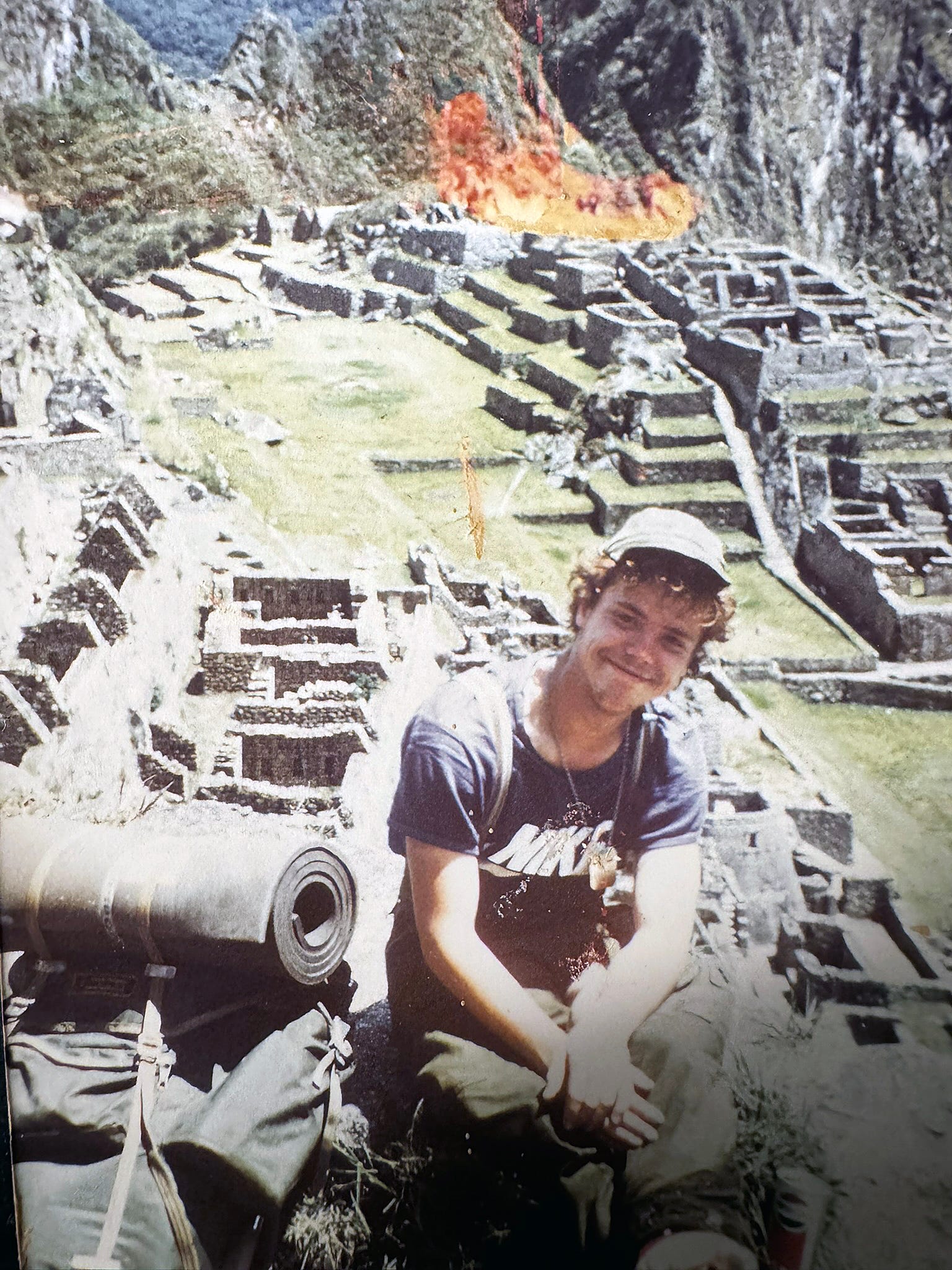
I found a photo of myself the other day.
I’m sitting on a stone wall at Machu Picchu. The terraces run down the mountain like green steps, and the house foundations look like a chessboard of grey stone. I’m wearing a green cap from my military service days and I’ve got a crooked smile, as if I’m used to sitting in places like this. In reality I’m completely worn out. The photo was taken just after I’d arrived from the Inca Trail. Four days, I think. My first hike ever. I was so exhausted I could barely look around. I was seventeen, maybe eighteen.
My gear is lying beside me. A big backpack and a sleeping pad strapped on as a roll. When I look at that roll today, I think that everything I was, everything I owned, and everything I thought I needed, is right there. A tent. A spirit stove. A few packets of soup and a lot of pasta. And a body that had no idea how to live out in the mountains.
I set out on the Inca Trail without really knowing anything. From home I’d brought old army clothes, a hat and a pair of trousers. My friend Mikael Tännström, two years older than me, and someone I’d grown up with in the small village of Dala-Järna, had come along. We’d bought these big, clunky Swiss hiking boots before leaving London. They caused a stir in the city. I remember people laughing, delighted, on the buses. We thought we looked like hikers. We weren’t. We were two boys looking for adventure, convinced the right shoes would take us far.
Food was the clearest proof of how little I knew. The first night on the trail I shoved as much pasta as I could into the pot and topped it off with a splash of water. I didn’t know how to cook. The result was a sticky lump you couldn’t really chew or swallow. I fell asleep hungry in the ridge tent Tännström had bought before we left, for 600 kronor.
The next night I decided I’d be smarter. I left the pasta to soak overnight, night two out of three on the trail. In the morning it was nothing but flour and sludge. I barely got any food into me during the whole trek, and that’s what caused the trouble. I was dizzy. I went the wrong way often. I panicked. I slid down some slope. Not because the trail was impossible, but because I was completely inexperienced. I didn’t come from a hiking culture. I’d never walked with a pack in the mountains. I hadn’t grown up with trails and that neat, organized Swedish outdoors life. It started here. With hunger, heavy missteps, and a spirit stove I thought I could handle.
And yet I was happy. I remember that. It was exciting. I was curious. I felt free in a way I didn’t have words for back then. And when I look at the photo now, it’s like I see two things at once. A young guy trying to look cool in a cap and a t-shirt, smiling at the camera. And another guy behind that look, completely drained, getting his first lesson in the fact that the world doesn’t care if you’re romantic and full of dreams. It demands that you learn how to boil pasta.
There’s something about the photo itself too. It’s worn. A little faded. There are scratches, and a scar up in the image. I like that. Memories aren’t supposed to be perfect. They’re supposed to be what they were. A bit scraped, a bit bruised at the edges, the way I was.
Before South America I’d already been out traveling in other ways. Two summers I did Interrail through Europe, fourteen and fifteen years old. I slept on trains, in parks, in cheap guesthouses, hung around stations, met people I never would have met at home. Then I went out into Europe again and hitchhiked, with a vague idea that I’d find work somewhere. I never did. It became three, four months of roads, waiting, new faces, small conversations, and that feeling that life really begins when you leave your home ground.
A big part of my longing came from the library. The library was the center of my life. I borrowed seven or eight books a week. I read and read and got inspired. That’s where the world opened up. That’s where the maps were. The travelogues. The novels set in places I couldn’t pronounce. The library was my internet before the internet existed. And it was slow, in a good way. You had to search. Wait. Ask. And you had time to think while you waited.
Mikael Tännström and I had decided we were going to leave Sweden and try to build a future abroad. The first idea was Australia. It made quite a splash in the local media that we were going. Curt Nilsson at the local daily ,Dala-Demokraten, newsroom in Vansbro was kind to me. I’d done my work placement with him, and now I was going to send reports home now and then. To me it felt like the beginning of a journalistic career. In reality, everything I sent was rewritten, so to speak. I wasn’t ready, but I got a sense that words could carry a journey. That you could be both the one who walks and the one who tells the story.
We ended up in Caracas, Venezuela. Tännström stayed a few days before he went back home. He missed his girlfriend Kerstin. He’d put her photo in his passport. When we sat at the travel agency sorting out tickets, his passport got passed around. Everyone looked at Kerstin, cheering. I had a photo of my girlfriend too, but it didn’t get the same attention, to my disappointment. That says something about the age. You’re old enough to cross oceans, but still young enough to care who gets the most looks in a travel agency.
I had just ended my first relationship before I left. She was six years older than me. An amazing girl. She wanted a steady life in Vansbro municipality, to stay, to settle. I had no interest in that. I wanted out. Not really to run from her, but because I couldn’t stand the thought of life being finished already. But I don’t remember fear. I remember curiosity. I don’t even remember my mother being worried. She let me go. And in hindsight it almost feels unreal.
When I look at my girls today, I often think of that kid in the photo. Would I let them, at seventeen, head off to South America with a tent, a spirit stove and a few packets of pasta, no phone, no insurance that covers everything, no constant contact home? I honestly don’t know. In some ways the world feels more dangerous now, even though it’s more controlled. They live in a time when everyone always sees what they do. When every choice can be compared to a thousand others on a screen. When they’re expected to know who they are before they’ve even had the chance to get lost.
It was a different time. There was no internet. No mobile phones. No blinking maps. No way to google what was waiting around the next bend. When you traveled, you really disappeared for a while. You called home sometimes from a phone booth if you found one. The rest of the time you existed only where you were. And maybe that did something to us. The world was bigger than our control. You had to ask people. Go the wrong way. Get hungry. Solve it.
Today the Inca Trail is something else entirely. Organized. Controlled. Regulated. Permits, bookings, groups, limits, guides. It makes sense in many ways. It protects this unique place. But it changes the feeling too. In my time it was rougher. More chance. More mistakes. I carried my own pack and my own faults. I went the wrong way because I didn’t know better. I learned by failing.
When I look at my girls and their generation, I think their journey is harder in a different way. They have access to everything, but they carry everything too. They live in a world where you’re constantly being seen. Compared. Measured. They somehow have to know who they are before they’ve even had the chance to get lost. And they carry a different kind of worry. The climate. The future. The pressure to perform. That feeling that you have to be right from the very beginning.
I wasn’t right. I was badly dressed, badly prepared, and I couldn’t even boil pasta. But I walked anyway. I kept going. And when I look at that photo, I think maybe that was my strength even then. Not bravery in some big heroic sense. Just curiosity so strong I didn’t have time to be afraid.
After that trip I started reading different kinds of books. Hermann Hesse, Siddhartha, things that pointed toward India. I wanted to go there. I went later. On that journey I met an Irishman who cycled from India to Nepal. And that’s where the ideas were born that later became my reality. Chile to Alaska by bicycle. All the journeys that followed. But it really begins here, with a young guy sitting on a stone wall in Machu Picchu with his backpack beside him and a sleeping pad strapped on as a roll, pleased on the surface and completely exhausted underneath.
And sometimes I think that’s what I want to pass on. Not that everything was better back then. It wasn’t. But that you can begin anyway. You don’t have to be finished. You don’t need a perfect plan. Sometimes it’s enough to walk. To learn along the way. To boil pasta wrong, to starve, to take the wrong turn, to panic, to get up, to keep going, and in the end to sit there and smile at the camera without understanding that smile will follow you for the rest of your life.